The Leprechaun Bar
MARRIED TO MY MASTER: A Bad Boy Hitman RomanceThe Leprechaun Bar is both an informal meeting place and the scene of a sudden armed confrontation in the story of Cormac MacKay and Scarlet O’Bannon. The bar first brings the two together to discuss unexplained disruptions in Cormac’s organization; later, as Mickey MacFarland’s takeover becomes a direct threat, it becomes the setting in which Cormac and Scarlet face armed men and escape immediate danger. Its significance comes from that change of function: a public place for conversation becomes a point of exposure when the mob conflict reaches them.
Setting and Physical Presentation
The bar is marked outside by a giant model leprechaun. Its green clothing has faded to grey under years of weather, while the sign is new, green, and flashing. The contrast between the battered figure and the recently renewed sign gives the entrance a mixture of age and active upkeep. The name and figure establish an Irish-themed identity, which fits the story’s focus on Cormac’s family and the Irish mob without making the bar itself a private headquarters.
Inside, the scene is recognizably that of a working bar: customers occupy a corner, women gather at the bar, and a booth gives Cormac and Scarlet a place to talk. The surroundings remain socially busy rather than secluded. During their meeting, a man in a leprechaun costume comes out of the kitchen carrying a birthday cake and sings to ten-year-old twins in matching red shirts. This ordinary celebration takes place alongside Cormac’s account of missing people and disrupted deliveries. The bar therefore holds two sharply different kinds of activity at once: a family occasion and a conversation about a crisis inside a criminal organization.
Cormac and Scarlet’s Meeting
Cormac is already at the bar when Scarlet approaches. He has contacted her through a drop box, claiming to have information, and calls to ask whether she is coming. Scarlet answers from a stairwell, identifies herself formally as Agent O’Bannon, and objects when he calls her Scar. Their exchange establishes the difference between her professional self-presentation and Cormac’s familiar manner toward her. She resists the nickname and delays her arrival, but comes to the bar half an hour later after changing into something less recognizably associated with the Federal Bureau of Investigation.
Cormac waits in a booth, one foot in the aisle, tracing the edge of his glass with a finger. At first he acts as though he does not know what information Scarlet expects. He drinks while she waits for him to continue, and the exchange makes the meeting feel less like a straightforward briefing than a negotiation over who will set its terms. Scarlet reminds him that he left the message and warns that their past cooperation against his rivals does not make his organization untouchable. The bar becomes the place where professional obligation, their earlier working relationship, and personal friction meet without resolving into trust.
Intelligence and Rising Stakes
Cormac’s reason for summoning Scarlet is his suspicion that someone inside his organization is responsible for a pattern of irregularities. Deliveries have gone missing, and people have disappeared. His cousin Mickey has been out of contact for about a week. Cormac has also learned that two missing men are being held in Los Angeles rather than New York City. He asks Scarlet what is happening, but she says she has no prior knowledge of the situation. Her answer leaves the source of the disruption unresolved, while establishing that the disappearances extend beyond a local dispute.
The birthday celebration continues during this disclosure. That detail sets the conversation’s high stakes against a routine public event rather than a room set aside for mob business. Cormac is not speaking in a secure or private headquarters; he is raising the possibility of a traitor, missing people, and the unexplained presence of prisoners in another city at a bar where other customers are present. The setting makes the exchange feel exposed even before the danger arrives. The bar’s ordinary social life does not contain the crisis, but it gives that crisis an unusually public backdrop.
The Confrontation
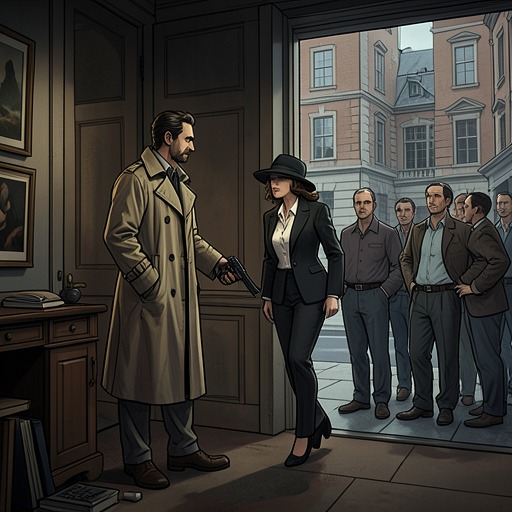
The danger becomes immediate when Moira MacKay calls Cormac and reports that their father has been killed and that Mickey has taken over the family. She warns Cormac that he is not safe and urges him to come to her. As she is speaking, five men associated with Mickey enter the bar. Their arrival confirms that the warning is not simply a family revelation delivered at a distance: the new power struggle has already reached the place where Cormac and Scarlet are meeting.
Cormac ends the call and turns his attention to getting Scarlet out safely. He interrupts her before she can mention the Federal Bureau of Investigation, fearing that disclosure of her connection could make her a target if Mickey has influence there. When one of the men insults Cormac’s family, Cormac fires and orders the group to leave. The other men surrender their weapons and head for the exit. Cormac collects a sawn-off shotgun and two handguns before turning back to Scarlet. One of the departing men warns that the threat against Cormac is not over.
Narrative Significance
The bar links information to consequence. At the first meeting, Cormac describes disappearances and uncertainty; when armed men arrive, the warning about Mickey’s seizure of power becomes an immediate physical threat. The shift is not a change in the bar’s basic public character but in what happens there: a booth that had served for a tense exchange of intelligence becomes the center of a confrontation from which Cormac and Scarlet must leave armed and alert.
The children’s birthday celebration sharpens that contrast without interrupting the action. A cake and a song are present at the same time as news of a murdered father, a disputed succession, and missing men. The Leprechaun Bar is thus more than a backdrop for the pair’s meeting. It is where the story places the fragile normality of an everyday public venue beside the consequences of mob violence, and where Cormac’s private family crisis first becomes a danger shared with Scarlet.